US Delays Iran Bombing: Stunning World Cup Final Move


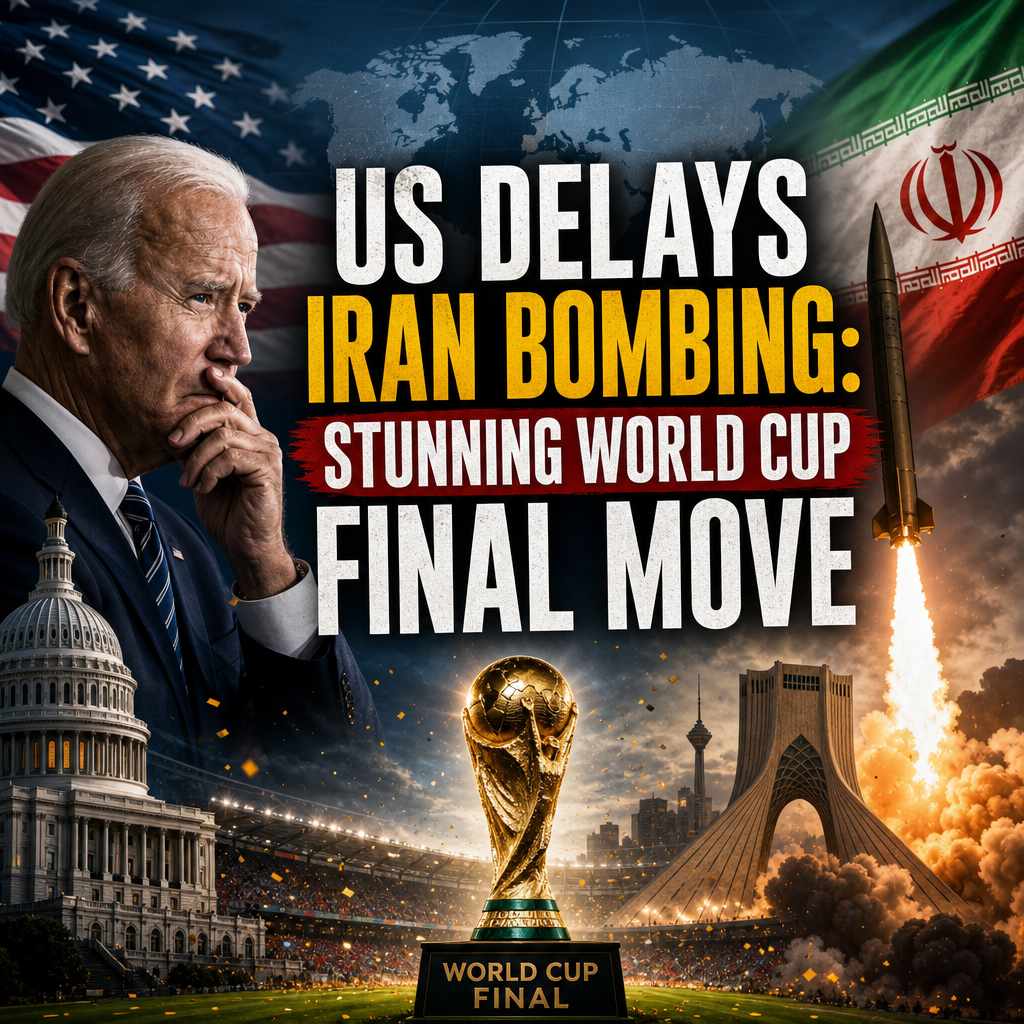
US Delays Iran Bombing has become one of those geopolitical stories that sits at the uneasy intersection of war planning, sports symbolism, and public messaging. What makes it stand out is not just the claim that military action was considered, but the timing: a major international sporting event allegedly became part of a discussion about whether and when the United States should strike Iran. That alone says a lot about how modern conflict is shaped not only by battlefield logic, but by optics, diplomacy, and the risk of global backlash.
The reporting and commentary around the issue point in different directions. Some coverage frames the episode as evidence of strategic restraint, suggesting Washington recognized that a bombing campaign during the World Cup could trigger outrage across the Middle East and beyond. Other outlets emphasize the more cynical interpretation: that the delay was less about restraint and more about choosing the most politically convenient moment to act. Meanwhile, broader international coverage, especially from Middle East-focused newsrooms, highlights how any such move would be read in Iran and the region as another sign that the U.S. still treats military force as a live option in its relationship with Tehran.



Why the World Cup mattered in the first place
The idea that a global football tournament could influence military timing may sound surprising, but it is not absurd. The World Cup is one of the few events that commands attention across borders, ideologies, and media systems. A strike during the tournament would have landed in a uniquely sensitive moment, when many countries were already watching the Middle East closely and when public opinion could swing quickly against escalation.
From a U.S. policy perspective, the calculation would have been complicated:




– A bombing campaign could disrupt regional stability.
– Civilian casualties or infrastructure damage would intensify international criticism.
– An attack during the World Cup would likely dominate global headlines in a way that undercut any attempt to frame the action as limited or defensive.
– Iran could respond asymmetrically through proxies, cyber operations, or pressure in the Gulf.
That helps explain why the reported delay is being read by some analysts as a sign of caution rather than hesitation. Even if military planning existed, timing an operation around a massive international event would have carried reputational costs that are hard to ignore.
At the same time, critics are right to ask a harder question: if the strike was genuinely under consideration, what does that reveal about the basic state of U.S.-Iran relations? The answer is not reassuring. It suggests a relationship in which diplomacy and deterrence remain unstable, and where the threat of force can re-enter the conversation quickly when tensions rise.
US Delays Iran Bombing and the politics of perception
The phrase US Delays Iran Bombing has gained traction because it captures more than a policy choice; it captures a narrative struggle. One side sees the delay as proof that public timing matters in foreign policy. Another sees it as confirmation that military planning can be shaped by media cycles as much as by security needs. Both readings have some merit.
This is where the source landscape becomes useful. RT’s framing tends to present the matter as an example of U.S. hostility toward Iran, with a strong emphasis on Washington’s alleged willingness to use force. Al Jazeera’s coverage of related regional tensions is typically more attentive to the consequences for civilians, diplomacy, and the broader Middle East balance. Sky News, by contrast, often approaches these stories through the lens of alliance politics, military credibility, and the risk of regional spillover. Put together, those viewpoints create a fuller picture: the issue is not just whether a strike was delayed, but what that delay says about how power is exercised and explained.
Three competing interpretations
The story can be read in at least three ways:
1. Strategic restraint
The U.S. recognized that bombing Iran during the World Cup would look reckless and provoke unnecessary international anger.
2. Image management
The delay was a PR calculation designed to avoid a globally embarrassing moment, not a meaningful commitment to peace.
3. Deterrence theater
The mere fact that such an option was discussed may have been intended to signal pressure on Iran, regardless of whether the strike was ever likely.
Each interpretation is plausible. What matters is that none of them point to a clean, simple policy environment. The episode reflects how foreign policy is often shaped by a mix of military readiness, media timing, and fear of political blowback.
What the story reveals about the broader Iran standoff
The deeper issue is not the World Cup itself. It is the continuing volatility of U.S.-Iran relations. For years, both countries have balanced confrontation with cautious restraint, with flashes of escalation often followed by back-channel diplomacy or public ambiguity. That pattern makes any reported bombing delay significant because it shows how close the region can come to a crisis before the brakes are applied.
There is also a human dimension that can get lost in the strategic talk. Any airstrike in or around Iran would risk civilian harm, economic disruption, and wider instability across neighboring states. Even if supporters of military pressure argue that Iran’s regional behavior must be checked, the cost of using force is still profound and difficult to contain.
The most responsible conclusion is that this was not a simple “missed chance” or a neat act of restraint. It was another reminder that major powers often weigh war and diplomacy against public perception, and that global events outside politics can sometimes shape the timing of decisions inside the room. In that sense, the real story is less about football and more about the uneasy way modern states manage conflict in front of the whole world.
US Delays Iran Bombing may sound like a sensational headline, but beneath it lies a serious question: when does caution become prudence, and when does it become merely the art of choosing a better moment to wage pressure? The answer, at least for now, remains unresolved.